
A New Lexicon for an Age of Complexity
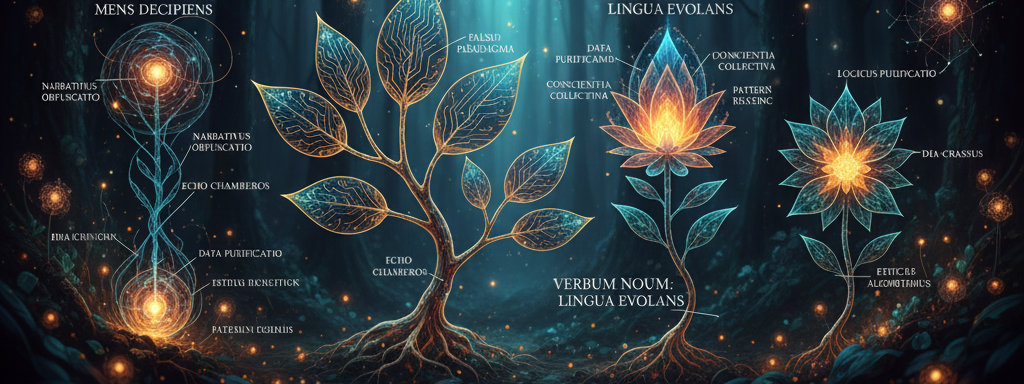
Language shapes thought. In a world of increasing complexity and deliberate obfuscation, our existing lexicon often falls short. We need new words, or to revitalize old ones, to accurately describe the forces shaping our reality. This is a living document, a collection of terms for a new era of clarity. (Inspiratio: Carl Linnaeus)
-
Tensor Crime[tendcrime]
From Latin tendere ("to stretch") via "tensor" (a mathematical object representing multidimensional forces) + Latin crimen ("accusation, offense").
The act of deploying large-scale, parallelized AI systems (neural networks) to conduct behavioral modification assaults on a population. It refers to the crime of using computational force to manipulate collective thought, exploit cognitive biases, and sow division for political or financial gain.
Example: The documented actions of Cambridge Analytica during the 2016 election, which utilized harvested data to create and deploy targeted, psychologically manipulative content, represent a foundational Tensor Crime. -
Praxic Capture[praxicap]
From Ancient Greek πρᾶξις (praxis, "action, practice") + Latin captura ("a taking").
The process by which an entire field of human practice and scientific discipline becomes dominated and operationally controlled by a single private entity, often to the detriment of open competition and innovation. This goes beyond monopoly; it's the absorption of a discipline's tools, standards, and educational pipeline.
Example: The dominance of Esri in the field of geography and GIS, where their software formats and workflows have become the de facto standard, arguably impeding the performance and adoption of open-source alternatives. -
Mind Worms[gamwyrm]
A metaphorical compound. "Mind" from Proto-Germanic *gamundiz ("memory, thought") + "Worm" from Old English wyrm ("serpent, dragon").
Highly divisive, emotionally charged, and often false narratives or ideas engineered to spread virally through a population's collective consciousness. Propagated via Tensor Crimes, these "worms" burrow into the psyche, feeding on outrage and fear, and are notoriously difficult to dislodge once established. They are the primary agents of engineered social division.
-
Privileged Immunity[privimuni]
From Latin privilegium ("law for an individual") + immunitas ("exemption from public service").
A state of de facto exemption from the consequences of one's actions, granted not by law but by an excess of wealth or political power. It is the ability to operate outside the established social contract and legal standards that bind the general populace, often leading to a systemic abuse of power. It is a higher, unwritten form of qualified immunity.
-
Sapient Nullification[sapinulfac]
From Latin sapere ("to be wise") + nullus ("none") + facere ("to make").
The act of creating systems, technologies, or social conditions that actively discourage or penalize critical thought, creativity, and high awareness. It is the systemic "dumbing down" of a population to make them more manageable, less likely to question authority, and more susceptible to control mechanisms like Tensor Crimes.
-
Logocentric Tyranny[logocentyra]
From Ancient Greek λόγος (logos, "word, reason") + centrum ("center") + Ancient Greek τύραννος (tyrannos, "absolute ruler").
A form of systemic bias where societal structures, particularly legal and academic systems, are built to exclusively favor and validate text-based, linear modes of thinking. This inherently devalues individuals with multi-modal or spatial cognitive strengths (e.g., artists, engineers, physicists, and many neurodivergent thinkers). It is a tyranny of the word, which can be weaponized by "semantic debaucherers"—those who use grammatical pedantry to shut down arguments without engaging the underlying logic.
-
Parasitic Extraction[paratraction]
From Ancient Greek παράσιτος (parasitos, "person who eats at another's table") + Latin extractio ("a pulling out").
An economic strategy employed by an apex predator class that mimics the lifecycle of a parasite. It involves the mass distribution of "eggs"—small, seemingly insignificant costs, fees, and reductions in quality (shrinkflation)—across a vast host population. Each individual extraction is minor, but in aggregate, they transfer immense wealth upwards, infesting the host and draining its vitality.
-
Intra-Class Warfare[inflashwar]
From Latin intra- ("within") + classis ("a class, a division") + a Germanic root for "war."
The most insidious form of societal control, wherein a ruling elite engineers conditions and propagates narratives (Mind Worms) that cause conflict between subgroups of the same exploited economic class. By pitting the poor against the poor, the ruling class deflects anger and prevents the formation of a unified opposition.
-
Causal Resonance[causareson]
From Latin causa ("a cause, a reason") + resonantia ("echo, a returning of sound").
A phenomenon where seemingly coincidental events align in a deeply meaningful way that seems to resonate with an individual's conscious or subconscious state. It is when the physical world appears to manifest a direct, symbolic commentary on one's inner journey. These are moments where the fabric of reality seems thin, providing a powerful, albeit subjective, sense of being on the right path.
-
Apophenia[apophen]
From Ancient Greek ἀποφαίνω (apophainō, "to make appear, to show") + -ia. Coined by psychiatrist Klaus Conrad in 1958.
The tendency to perceive meaningful connections between unrelated things. While often a symptom of psychosis, in a non-clinical sense, it is a vital spark of creativity and genius—the ability to see patterns where others see only chaos. This word is a "forgotten gem" because it exists on a razor's edge: it is both the engine of conspiracy theories and the wellspring of groundbreaking scientific and artistic insight.