Current AI excels based on static training, ill-suited for the dynamic, unpredictable, and often non-stationary nature of real-world data streams. To achieve true adaptability—essential for processing continuous sensor feeds (like for the **Gaian Mind**) or powering next-gen GIS (like **Magpi**) —we need AI architectures capable of **continual, lifelong learning** directly on operational hardware. We envision systems that dynamically adapt their processing, memory, and even core logic at runtime: an **"Open Compile"** approach built for silicon, enabling the "Thread Weaver" vision of a continuously evolving AI partner.

This document outlines the core concepts, integrating state-of-the-art research in lifelong learning, adaptive compilation, and meta-learning.
Access the full, collaborative research document:
Open Compile (Google Docs)
(Tip: Open link directly for the best mobile viewing experience.)
1. The Need: AI That Learns Like Life (On Silicon Now)
Static training fails in dynamic environments. True adaptability for projects like Gaian Mind (sensor feeds) or Magpi (GIS) requires **continual, lifelong learning** on operational hardware (CPUs, GPUs, TPUs, FPGAs). We need an "Open Compile" approach for a "Thread Weaver" AI that evolves.
2. The Vision: Dynamic Adaptation at Runtime - The "Thread Weaver" Engine
The Open Compile AI functions less like a fixed program, more like a living system:
- Learns Continuously: Integrates new data without catastrophic forgetting (**Lifelong/Continual Learning**).
- Manages Memory Dynamically: Reinforces relevant pathways, allows irrelevant info to fade algorithmically (**Adaptive Memory Management**).
- Optimizes Itself: Reconfigures internal structure and recompiles code at runtime based on task/data (**Runtime Self-Optimization / Meta-Learning / Adaptive Compilation**).
- Interacts Deeply ("Bare Metal Vision"): Manages own resources, potentially interfaces with OS kernel (**AI OS / AI-Native Systems**).
3. Achieving Open Compile on Silicon (Integrating State-of-the-Art Techniques):
Leverages current and emerging research:
- Advanced Adaptive Compilation & JIT: Dynamic recompilation (using LLVM, XLA, TVM, Mojo etc.) and specialized code generation at runtime based on data/hardware state.
- Dynamic & Modular Network Architectures: Conditional computation (MoE), adaptive structure (RigL, SET, Online NAS like AdaXpert), composable modules with hot-reloading for live updates.
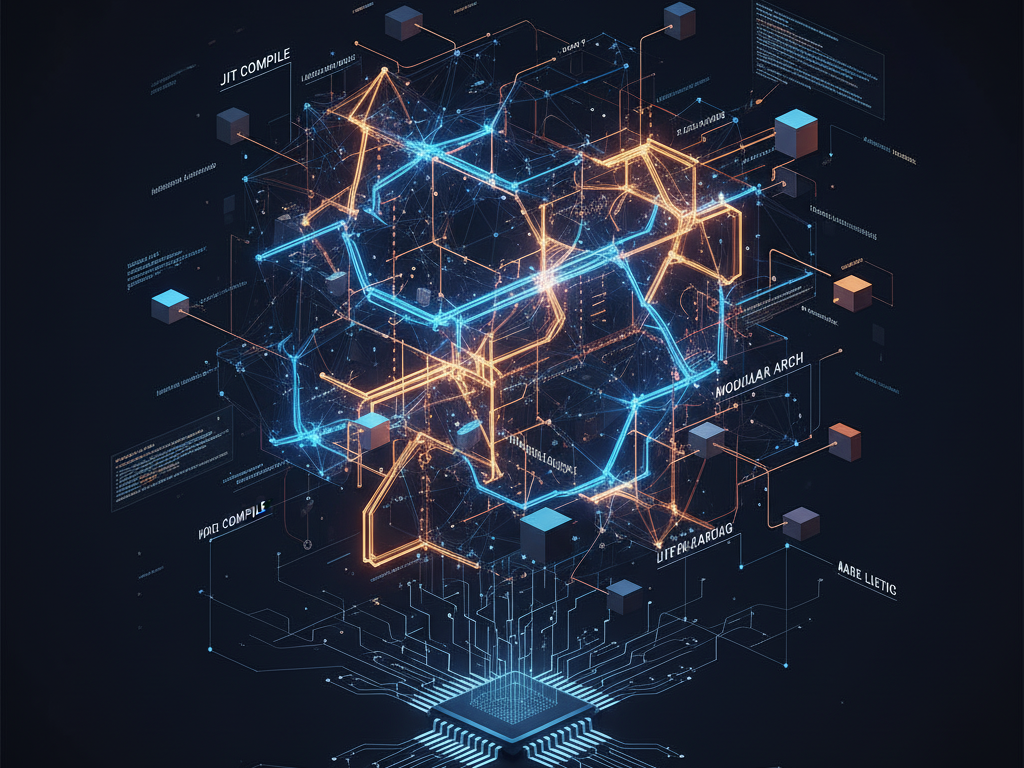
- Lifelong Learning Algorithms: Hybrid approaches combining regularization (EWC, SI), rehearsal (ER, SER, GR, MIR), and architectural methods (Progressive/Dynamic Networks) to balance stability and plasticity.
- Meta-Learning (Learning to Learn & Adapt): Runtime hyperparameter tuning (MAML, Reptile, FTRL, AdaXpert) and self-correction mechanisms based on performance monitoring.
- Towards Deeper OS Integration ("Bare Metal"): Resource-aware AI adapting computation based on OS metrics; future research exploring kernel bypass/direct hardware access.
4. Application: Powering the Gaian Mind & Magpi
Directly addresses project needs:
- Gaian Mind: Adapts to non-stationary sensor drift, dynamically allocates resources for events (e.g., solar flares), integrates history without forgetting, meta-learns optimal sensor fusion.
- Magpi GIS: Adaptive JIT for spatial operations, dynamic pipelines based on data complexity, efficient out-of-core processing for massive datasets.
5. Challenges & The Path Forward (Informed by Research):
Key hurdles identified in research:
- Stability & Verification: Ensuring self-modifying systems remain predictable and safe (requires advanced testing, formal methods, runtime safety monitors like interval observers or stochastic barrier functions).
- Computational Overhead: Runtime adaptation costs resources. Efficiency requires techniques like caching, lightweight adaptation (e.g., ATLAS), and asynchronous processing.
- Debugging & Explainability: Understanding dynamic systems needs advanced monitoring and XAI tailored for evolving models.
Path forward: Incremental integration in modular architectures, prioritizing stability and efficiency at each step.
6. The NexaVision Connection:
The "Open Compile" architecture provides a **practical software and silicon-based pathway** towards the adaptive AI ("Thread Weaver") needed for NexaVision's goals. It leverages state-of-the-art research to create dynamic, learning partners embodying **evolution in action**. *(Explore more at nexavision.tech)*